Early departure this morning - due to check in at the Interislander Ferry Terminal at 8:10 a.m. for a 9 a.m. sail. We had to turn in our rental car before boarding, as the rental companies keep separate fleets on the north and south islands. We stood in line to check our luggage just like we were boarding a plane, getting our boarding passes at the same counter. The terminal was crowded with backpackers and conversations in many languages.
One of the ferries in Wellington Harbour
We boarded the huge ship Kataki and scouted out a place to sit on one of the many levels. We found some empty seats up on the top, open-air deck. We saw Westpac Stadium, home venue to professional rugby and soccer teams, including the famous All-Blacks, as we departed Wellington Harbour. The nearly sixty-mile journey took around three hours and was a beautiful, scenic ferry ride.
Once the ferry left the harbor, the wind picked up considerably. We were excited to spot some dolphins leaping and diving through the water. We eventually wandered down to the lower, indoor levels, enjoying coffee, tea and Chinese checkers. The ferry had several cafes, bars, lounges, and even a small movie theater. Groups of youngsters sped through the corridors and up and down the busy stairways.
The ferry circled around the southern tip of the North Island, headed northwest across Cook Strait, and bypassed the usual Tory Channel route to the more northern entrance into Queen Charlotte Sound. The captain announced the change of course, saying the clear, calm weather offered an opportunity for the pilot to clock some required hours maneuvering through the northern passage. The travel time was unaffected by the change, and we docked in Picton around 12:30 p.m.
One of the many wind farms in NZ
We collected our bags and made our way to the EuropCar rental office. With an entire ferry of tourists arriving at once, you can imagine the lines at the rental shops. But the line moved fairly well, and this time we were able to register both of our driver's licenses. Tim was already a pro, but I was psyched to try driving on the left.
From the little town of Picton, we followed the valley south to Blenheim, which sits at the heart of Marlborough, New Zealand's largest wine region. Saw lots of sheep and vineyards along the way.
(Full disclosure - these are North Island sheep. Sheep are everywhere here.)
We checked in at Chateau Marlborough Blenheim, a big, fancy name for a not-so-big-and-fancy hotel. The not-so-cheery receptionist recommended a pizza place in town for us - probably the only pizza place in this little town. On the other hand, this and all other towns we visited seem to have Thai restaurants on every corner. Kiwis are clearly Thai food fanatics.
Requisite potty shot - this flimsy toilet hung precariously from the wall of our room at the "chateau"
I was all set to have my first turn at the wheel, when I took a chunk out of my finger trying to adjust the headrest. Not wanting to bleed all over the steering wheel, I relinquished the keys to Tim. He drove to Dolce Pizza, a second-floor local eatery overlooking the little business district, busy with big tables of students and families. I was pleased with myself for remembering the the British term for band-aid, and asked if I could please have a "plaster." After showing me the "pasta" section of the menu, the waitress got my drift and brought me a bandage.
After dinner, I was well-plastered and took the wheel. Remembering to stay on the left side of the road was pretty easy. The tricky part was to look up and to the left for the rear view mirror, and to remember the turn signal on the opposite side of the steering column. Tim and I both turned on the wipers countless times by accident during our trip. Not finding much of interest in town, we headed back to our "chateau" for the night.
a large brown wingless insect related to the grasshoppers, with long spiny legs and wood-boring larvae, found only in New Zealand.
Nice breakfast at the lovely Bolton hotel in Wellington, then a short drive around the scenic Wellington Harbour to the Miramar peninsula. Here we would enjoy a tour of the magical Weta Cave, co-founded by Richard Taylor and Peter Jackson. Artists and craftsmen create physical effects for the Lord of the Rings movies, and countless other films, in this unassuming, one-story building in the middle of an unassuming neighborhood of one-story houses. Without a parking lot available, visitors circle the streets in search of curbside parking. I felt sorry for the residents of this neighborhood, until I learned that most of them are part of the Weta team.
Once we found a parking spot, we walked around the front of the building, and were greeted by three handsome trolls, Tom, Bert and William. Charming chaps.
Arriving a bit early, we were able to jump in on an earlier tour. Just inside the doors of the "cave," I snapped a photo before the tour guide joined us and said no photography was allowed. All of the props and costumes inside are still property of the production companies of the various films, and they hold the copyrights. So, imagine, if you will...
The first display was a gun from District Nine, the various molds and versions in wood and plastic painted to look real and worn. We saw the face molds of Ian Holmes and Elijah Wood, and a cool animatronics goblin head that was controlled by a hand-held device not unlike a video game controller. It was fascinating to see all the different facial expressions it could make. A model castle for the Narnia movies sat in one corner, and Gimli's helmet was in a glass case, along with other helmets and swords. We held various latex prosthetics and some very real-looking chain mail that was extremely lightweight and made of tiny plastic rings. Lifelike Sauron and Avatar models looked down on us as we neared the exit, and we saw some hair pieces made from either real human hair or yak hair, hand-sewn hair by hair, making them worth thousands of dollars.
We spoke with one of the artists who was working on some independent contract work. The artists on staff are allowed to use the facilities for their own projects when Weta has no work for them. This allows Weta to keep the talent between projects. When a project is in full swing, the size of the staff swells with temporary workers, but a skeleton staff is maintained on a more permanent basis.
Back inside the main entrance was a LOTR-lover's dream world. Every possible LOTR souvenir imaginable was available here, along with items from other Weta projects. Displays here included a Gollum statue, and Urukai model, and some Hobbit feet. I asked the sales staff what a weta was, and one young man took me outside where we found a small, grasshopper-like bug hanging out under one of the troll's leather wraps.
A short film about Weta (the company, not the bug) was shown in a tiny dark room in the back. Weta began with the chance meeting of Peter Jackson and Richard Taylor, two amateur filmmakers working out of their garages at the time. From those humble beginnings, it was amazing to see the number of high-profile projects in which Weta has been involved. They are not only contracted for movies, but have also done the TV series Thunderbirds Are Go and an exhibition commemorating the Gallipoli war, one of the most important events in New Zealand's history. Weta also has a digital arm that has done the computer graphics special effects on numerous films.
After picking up some postcards, we drove back to the waterfront we'd passed on the way and found a little cafe, Beach Babylon, to have some lunch while enjoying the view. We pulled out our chinese checkers and attracted the attention of an older British gentleman who was waiting with a large group of tourists. He told us how he and his siblings often played on a set his father made for them. I love when people share their stories!
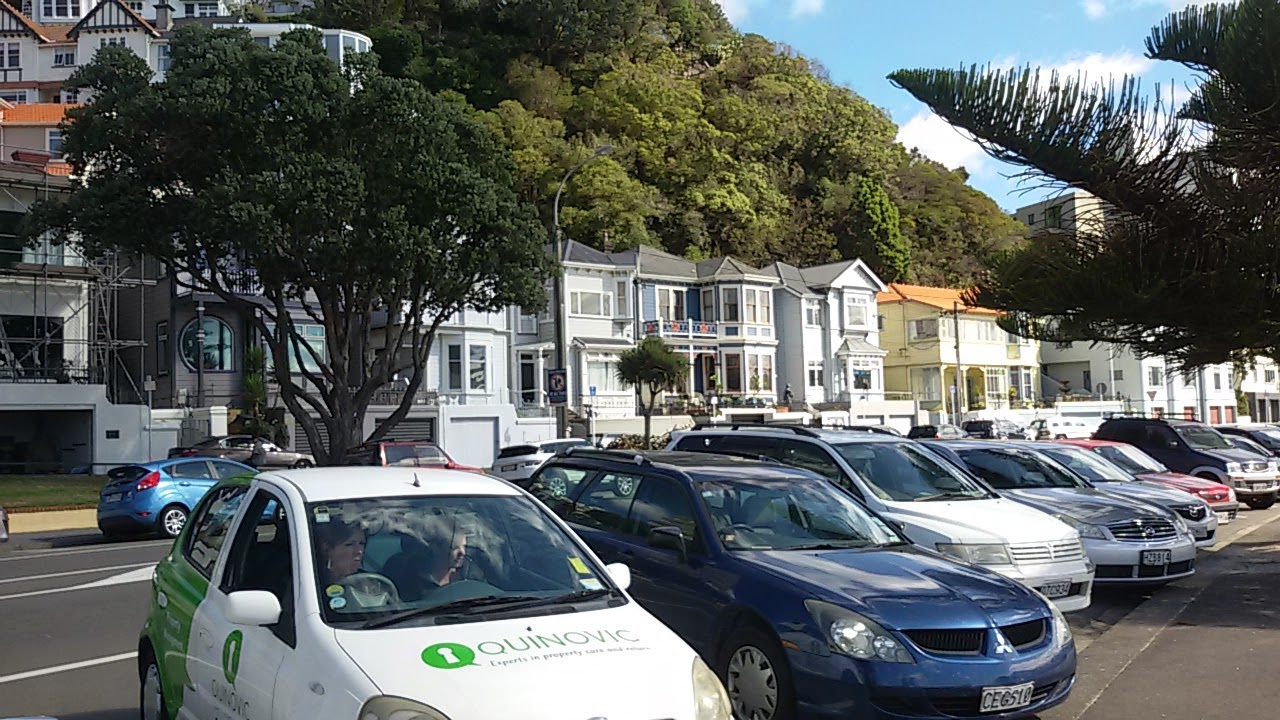
The city has a bit of an American West Coast vibe
We walked across the road and sat on a bench on the waterfront, watching two sea gulls dine on what we soon realized was a dead penguin. What appeared to be a class of kayaking students paddled into the bay, and a couple of them felt they should bury the penguin. The sea gulls seemed perplexed by this turn of events.
Back in town, we had a little time to walk around the city. Wellington is the capital of New Zealand and has many stately buildings on its hilly streets.
In the evening, it was another short drive to Zealandia, a protected natural area in a busy suburb of Wellington. It is billed as the world's first fully fenced urban eco-sanctuary. Mary, another transplant from Ft. Collins, CO, was to be our guide for the Zealandia Night Tour. Our small group of seven included Mary, her assistant Douglas, a NZ dairy farmer and his wife, and a young french woman. A self-check of everyone's packs ensured we weren't bringing any unwanted stowaways into the park. We were given small flashlights with red lights that would enable us to see things in the dark without disturbing the wildlife. A set of double gates insured no unwanted critters joined us on our twilight tour.
Sign for the cafe
This unique eco-attraction is an attempt to restore all native flora and fauna and eradicate all invasive species. Europeans brought many invasive plants and animals when they arrived. Before their arrival, NZ had no native mammals, no snakes, no poisonous spiders - amazing. This ambitious project enclosed 225 hectares (about 555 acres) inside a sophisticated, nearly impenetrable fence, then set about trapping and removing all the invasive mammals. Many of NZ's native birds are flightless, and as such are defenseless against non-native predators. (They have discovered that baby mice can still slip through the fence). Zealandia staff says they are twenty years into their 500-year-plan of restoring the natural habitat - a very ambitious project.
the Takahe (it was getting dark)
As we entered, we heard the songs of several species of birds that are now flourishing in this restored habitat, like the Kaka and the Tui. As the sun disappeared, these songs died out and we heard the songs of the nocturnal creatures, including the elusive kiwi and the little morepork owl. In a little enclosure we encountered a pair of Takahe, big, blue flightless birds with red beaks, who followed closely on our guide's heels until she fed them. These were once thought to be extinct.
A full moon shone as we made our way along the paths. The assistant, Douglas, went ahead and located a tuatara, a prehistoric-looking lizard. We were lucky to spot two different kiwis in the underbrush - such strange, awkward-looking birds. We saw many more wetas on the underside of a tree, and marveled at the blue luminescence of hundreds of glowworms, which are not actually worms, but the larval stage of an insect. The Maori name for glowworms is Pura Toke, meaning "one-eyed worm." We tasted the leaf of the horopito, a peppery-flavored plant used by the Maori for many medicinal purposes. Mary pointed out an enclosure that occasionally houses a rather famous, rare, kakapo parrot named Scirocco, when it comes for a visit. Scirocco was made famous by an amusing viral video from Stephen Fry's Last Chance to See series. Click Shagged by a Parrot to see. We had a glorious view of the Southern Cross as we walked back to the entrance. Inside, we all enjoyed a cup of horopito tea before saying good-bye.
Walked back to Bethel Woods for dinner again - the ribs were calling Tim's name. The angry-looking waitress from the night before was now all smiles. Tomorrow we leave the north island and head south.
Today we drove a beautiful route southeast from Rotorua to Napier. A stop at Wai-O-Tapu was recommended, but when we arrived, I was reluctant to pay the entrance fee. Tim talked me into it, and I'm so glad he did.
Sign of the times...
Wai-O-Tapu is a very colorful and diverse geothermal area, rated on Trip Advisor as one of the most surreal places in the world. If you've been to Yellowstone, you understand the "otherworldly" nature of such a place. We had several different trails to choose from, all well-tended and easy to navigate. We could get up close and personal with bubbling mud pools, steaming, brilliantly-colored springs and ominous-looking underground caves.
Another American(!) guide here gave several talks around the park. She said that capturing the geothermal energy as alternative power had significantly lowered the water table all around the island. Where there were once 130 geysers, now only thirty remained. We also learned that the seemingly inhospitable hot springs are actually teeming with tiny creatures called extremophiles.
Extremophiles are organisms that live in extreme conditions of temperature, acidity, salinity, pressure, or toxin concentration. The main types of extremophile found in geothermal areas include:
thermophiles (heat-loving)
acidophiles (acid-loving)
thermoacidophiles (heat- and acid-loving).
For an organism to be classified as an extremophile, it must live its entire life at these unusual conditions. Many will actually die if conditions are less extreme.
The hike was beautiful and fascinating, with so many unique things to see. One pool was a startlingly-bright neon green, and so acidic that birds flying too close to the surface would die, their bodies soon dissolved in the acid.
mud "river"
"Champagne Pool"
Next we drove to Huka Falls, an intensely powerful and beautiful sight. This set of waterfalls on the Waikato River originates at Lake Taupo. The river narrows from 100 meters across to just fifteen meters across, and all that water slams through the narrow canyon walls at 220,000 liters per second. The water is a brilliant blue topaz crowned in icy white. I could have watched it for hours.
It was a beautiful drive through the rugged Ahimanawa Range. We stopped for lunch in the city of Taupo, where we watched an intense game of giant chess in the park.
backpacker vs. local senior
From there it was on to John Hawkes Bay and the city of Napier, the "Art Deco Capital of the World." This city on the Pacific Coast was rebuilt after a 1931 earthquake, and has a vague sense of an old black-and-white movie set. We checked into the groovy-looking Scenic Hotel Te Pania, which had a retro sixties vibe.
Not much was opened as we strolled through town. A lovely sculpture of the kow hai flower was illuminated in the town square. We had dinner at the Hog's Breath Cafe and called it a night.
Next morning, after a so-so breakfast, we took a stroll along the tree-lined waterfront, the best part of our stop in Napier. Massive Norfolk Island Pine trees lined the walkway, stunningly straight and symmetrical - the cones were huge and the "needles," if you can call them that, were bigger than my foot! An enclosed concrete pier jutted out over the ocean and the rocky beach. We could hear the mesmerizing sound of the small rounded stones clicking together as the waves receded.
Art deco architecture
A lovely, small garden gracing one end of the beach is home to the notable Pania of the Reef statue. Pania of the Reef is a character from Maori mythology.
We enjoyed yet another beautiful drive, today from Napier to Wellington on the southern end of the north island. We passed through the massive Manawatu Gorge, and left the main highway in search of some set locations from the Lord of the Rings movies. The atlas given to us by the travel company showed the locations of Helm's Deep, the Rohan River, and Minas Tirith, just to name a few. This was indeed a treacherous decision, as we found ourselves winding up and down Akatarawa Road, a single-lane mountain pass with no visibility of what was approaching from the other direction. Locals barreled through like it was nothing, but we cautiously maneuvered each and every twisty turn. I was so glad I wasn't driving, but Tim bore the full force of my anxiousness, poor guy. And we never did find the locations we were looking for.
At last we made it back to the main highway and encountered the only significant traffic of our trip in Wellington, the capital city of New Zealand. We checked into the fabulous Bolton Hotel, where we enjoyed the in-room kitchen, sitting room, and, most importantly, a washer! The only downside was the parking, which was in a structure across the street. It was pricey, and the low ceilings and narrow turn radii were a bit daunting. We nearly broke off the antenna of our rental when we had to back up one of the ridiculously steep and narrow ramps. After that, we decided the valet parking was the way to go.
The concierge sent us up the street to a great pub, Bethel Woods, for dinner. We enjoyed some delicious pub grub, and live music that made us miss our boys.